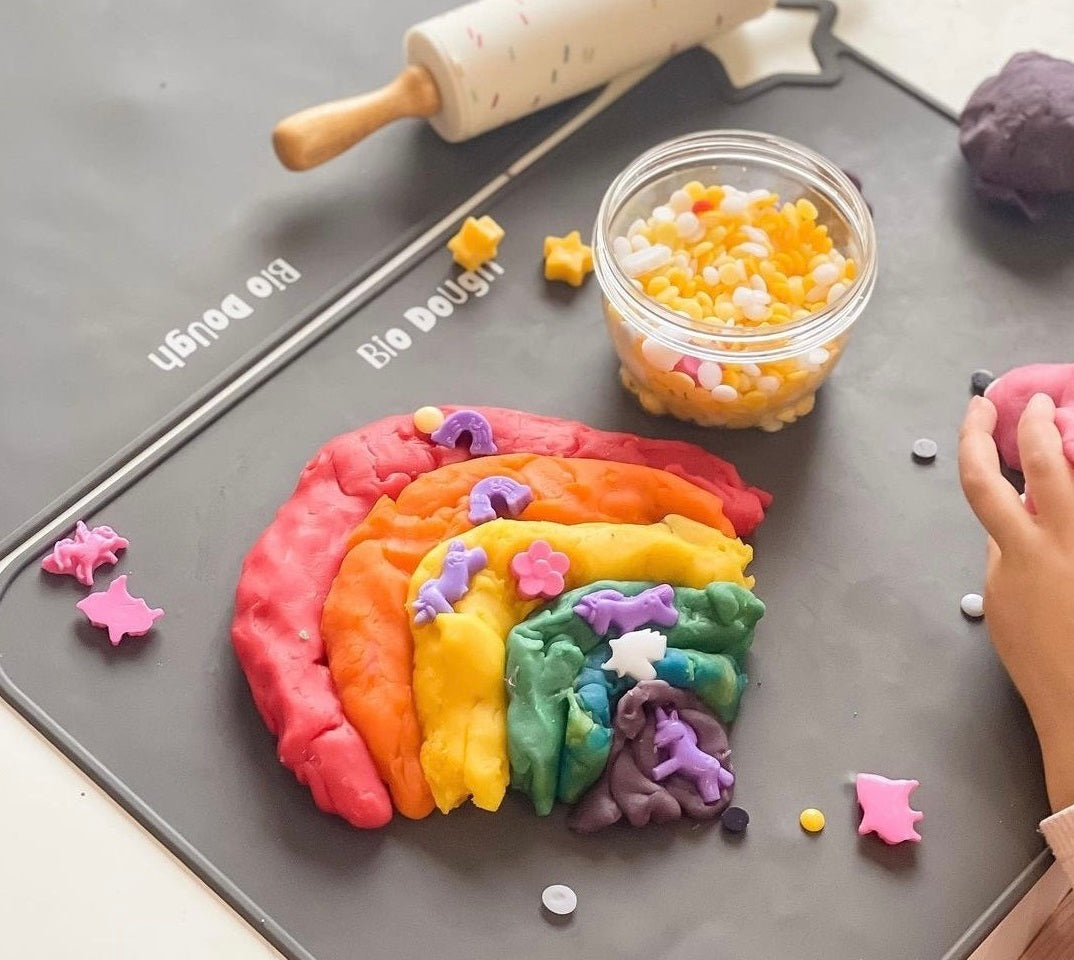
Cloud dough, playdough and slime are all hands-on play choices, but they act very differently. Cloud dough is usually soft and crumbly, so it works well for scooping and packing. Playdough is firm and easy to shape, so it holds cutters, models and pretend scenes. Slime is stretchy and flowing, so it suits pulling, folding and watching shapes change.
The best choice depends on the exact ingredients and age label. It also depends on whether your child mouths objects, which textures they like and how much mess you can manage. A familiar name is not enough because cloud-dough and slime formulas vary widely.
The Main Differences
| Feature | Cloud dough | Playdough | Slime |
|---|---|---|---|
| Typical feel | Soft, silky or crumbly | Soft, firm and mouldable | Wet-feeling, stretchy or jiggly |
| Holds a detailed model | Poor to moderate | Best of the three | Poor |
| Best actions | Scoop, crumble, pack, press | Roll, pinch, cut, stamp, build | Stretch, fold, pull, pour |
| Common formula | Flour and oil, or cornflour and conditioner | Flour, salt, water and oil, with commercial variations | Glue or polymer base plus an activator, with many variations |
| Mess pattern | Fine crumbs or powder can travel | Usually contained in pieces, but can mark soft surfaces | Can stick to fabric, carpet and hair |
| Storage | Formula-dependent, often short-lived | Airtight container | Airtight container, formula-dependent |
| Key checks | Raw flour, cosmetic ingredients, allergens, mouthing | Wheat or other allergens, salt, age label, mouthing | Product label, activator ingredients, skin and eye contact, mouthing |
| Strongest use case | Sensory bin and mould packing | Modelling, tools, pretend play and repeat activities | Stretch and flow exploration for an age-appropriate child |
First, What Does "Cloud Dough" Mean?
Cloud dough is not one standard recipe. The name is used for at least three different types:
- Flour-and-oil cloud dough: dry, silky and crumbly, often compared with soft sand.
- Cornflour-and-conditioner cloud dough: softer and more cohesive, with the scent and cosmetic ingredients of the conditioner.
- Cloud slime or cloud-dough slime: a slime-shop texture with polymers and other add-ins. It is not the same as the crumbly sensory-bin recipe.
Before choosing cloud dough, read the full ingredient list or recipe. The word "cloud" does not prove that it is safe, edible or free from allergens.
What Makes Playdough Different?
Playdough is designed to be shaped and reshaped. It can roll into a rope, flatten under a rolling pin, take a cutter impression and support pieces joined into a model. That predictable resistance makes it useful for:
- Pretend food, animals and characters
- Letter, number and shape play
- Rolling, pinching, pressing and cutting
- Collaborative scenes and storytelling
- Repeat sessions when stored correctly
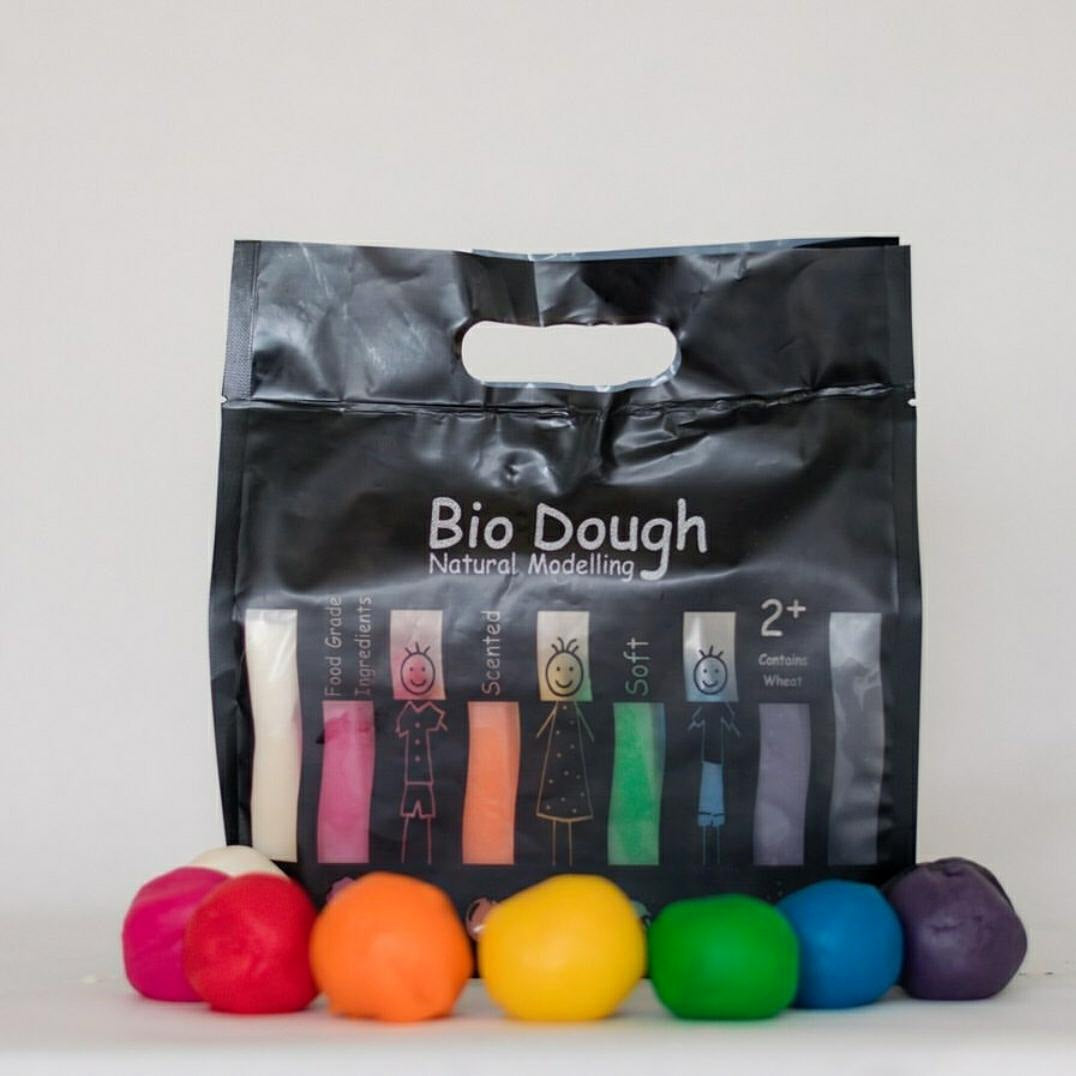
Shop-bought and homemade recipes vary. Bio DoUgh is Australian made with 100% food-grade ingredients. It is for ages two and over, contains wheat and is not edible.
What Makes Slime Different?
Slime flows slowly, stretches and folds. It does not hold a stable, detailed model. Recipes and products may use school glue, starch, contact-lens solution, borate compounds, shaving foam, colour, scent, beads or other add-ins.
That variety means "slime" is not a full ingredient description. A labelled product and a homemade recipe can have very different contents, warnings and age guidance.
Do not let children handle household borax powder or guess the amount to use. The NSW Food Authority warns that swallowing borax can cause serious poisoning. Australians can call the Poisons Information Centre on 13 11 26 after a possible exposure. Contact-lens solution is a medical product. Its presence does not prove that a slime recipe is suitable for children.
Which Material Holds Shapes Best?
Playdough is usually the clear choice when the activity involves building or tools.
| Play goal | Better fit | Why |
|---|---|---|
| Cut recognisable shapes | Playdough | It holds a flat sheet and clean cutter outline. |
| Build an animal or person | Playdough | Joined parts remain where they are placed. |
| Fill and tip a sensory scoop | Cloud dough | Crumbly material pours and packs. |
| Make a sandcastle-style mould | Cloud dough | Many formulas compress into a mould, then crumble. |
| Pull a long strand | Slime | Stretch is the central behaviour. |
| Watch a material flow | Slime | It changes shape under gravity. |
| Make letters and numbers | Playdough | Ropes and flattened shapes remain readable. |
| Hide and excavate large objects | Cloud dough or playdough | Choose based on desired crumbly or firm resistance. Avoid small parts. |
Which Is Easiest to Clean Up?
None of the three is mess-free, but each makes a different kind of mess.
Cloud dough mess
Flour-based cloud dough can release fine crumbs and powder. Oil may mark some surfaces. Versions made with conditioner can leave scent or residue. Use a rimmed tray on a floor you can wipe, and keep the dough away from food.
Playdough mess
Playdough usually stays in larger pieces. Fresh dough can smear if rubbed into carpet or fabric, while dried residue may crumble away. Use a mat, tie back hair and collect pieces before they travel. For an accident, see how to get playdough out of carpet, hair and clothes.
Slime mess
Slime can stretch into fibres, hair and soft furnishings. Play only over a hard, washable surface. Keep slime away from carpet, soft furniture, bedding and clothes that cannot be spot-cleaned. Follow the product's clean-up steps.
| Home priority | Most manageable starting point |
|---|---|
| Detailed table play with a mat | Playdough |
| Outdoor or tray-based crumbly play | Cloud dough |
| Stretch play on a hard protected surface | Labelled age-appropriate slime |
| Carpeted room | Playdough on a large mat, with close boundaries |
| Very low tolerance for scattered crumbs | Playdough rather than flour-based cloud dough |
| Very low tolerance for sticky residue | Playdough or a crumbly cloud dough, not slime |
Ingredient Checks Before Choosing
Cloud dough
- Is the flour commercially heat-treated, or is it ordinary raw flour?
- Does the recipe use conditioner, baby oil or another cosmetic product not intended for mouthing?
- Are there fragrances, nut oils or other allergens?
- Will the material be discarded after the session or stored?
The FDA explains that ordinary flour is generally raw and advises against allowing children to play with raw flour dough. It also warns that home heat-treatment methods may not reliably make raw flour safe.
Playdough
- What age does the label specify?
- Does it contain wheat or another allergen?
- Is it non-toxic but clearly labelled as not edible?
- Does the product include small accessories with a different warning?
- How should it be stored and when should it be discarded?
Slime
- Is it a labelled children's product from a traceable supplier?
- What are the age, skin, eye and ingestion warnings?
- Does it contain borates, fragrance, glue, contact-lens solution or small add-ins?
- Does the child have broken or irritated skin?
- What does the label say about contact time, storage and disposal?
Do not rely on social-media terms such as "taste-safe", "chemical-free" or "non-toxic". Look for a full ingredient list and clear product guidance.
Which Is Best for Toddlers?
For Bio DoUgh, wait until at least age two and then check readiness. A toddler should mostly keep objects out of their mouth. They should also follow a simple direction and remain close enough for direct adult supervision.
There is no single toddler age for cloud dough or slime because recipes differ. Follow the exact label. Cloud dough made with raw flour, cosmetics or oil is not always a safer choice. Homemade slime can add glue, activators and a very sticky clean-up.
| Child situation | Practical choice |
|---|---|
| Under 2 | Choose a sensory activity specifically designed for infancy. Do not offer Bio DoUgh. |
| Age 2+ and ready for dough | Try one large piece of playdough with no small accessories. |
| Still mouths toys | Wait, regardless of material name. |
| Dislikes sticky textures | Playdough or a carefully checked crumbly material may be more comfortable than slime. |
| Dislikes crumbs or powder | Playdough may be easier to contain than flour-based cloud dough. |
| Seeks stretch and is old enough for the product | A labelled slime may suit, with hard-surface play and direct supervision. |
Read the full playdough age and readiness guide before a first session.
Sensory Preferences: There Is No Universal Winner
One child may love the resistance of playdough and dislike slime on their fingers. Another may enjoy flowing slime and find crumbly cloud dough irritating. Sensory play should be offered, not forced.
Try a small amount and watch the response. A child can use a roller, scoop or large tool instead of touching it. Stop if the child is upset, develops sore skin or keeps using it in an unsafe way.
Be careful with claims that a material is calming, regulating or therapeutic. A pleasant sensory activity may help a child take part. It does not treat a sensory condition by itself.
Fine-Motor and Learning Differences
| Material | Common hand actions | Play and learning opportunities |
|---|---|---|
| Cloud dough | Scoop, rake, crumble, compress, tip | Volume language, cause and effect, mould filling, sensory description |
| Playdough | Squeeze, roll, pinch, poke, cut, stamp, join | Model building, pretend play, shapes, counting, stories and varied hand practice |
| Slime | Stretch, pull, fold, squeeze, pour | Material change, prediction, comparison and stretch exploration |
The value comes from what the child does during play. No dough or slime can promise a development result. For more hand-play guidance, see playdough and fine-motor skills.
Storage and Hygiene
Always follow the exact product or recipe, but these general principles apply:
- Wash and dry hands before and after sensory play.
- Use a clean, dry surface and clean tools.
- Keep all play materials away from food and drinks.
- Do not share material that has been mouthed or visibly contaminated.
- Label homemade batches with the ingredients and date.
- Store only when the recipe or product provides a safe storage method.
- Keep containers out of reach when not in use.
- Discard material with mould, unexpected odour, unusual colour, separation or contamination.
- Never pour slime or oily cloud dough down a drain unless the manufacturer explicitly permits it.
The NHMRC playdough hygiene guidance recommends handwashing, airtight storage and discarding mouthed or visibly contaminated dough in education and care settings.
Five Questions to Choose the Right Material
- What action interests the child? Build and cut points to playdough. Scoop and crumble points to cloud dough. Stretch and fold points to slime.
- What does the exact label say? Check age, ingredients, allergens, warnings, storage and disposal.
- Does the child mouth objects? If yes, wait or select an age-specific activity designed for that stage.
- Where will play happen? Use a hard, washable surface and match the material to your tolerance for crumbs, oil or stickiness.
- Can an adult supervise directly? If not, postpone the sensory session.
Why Choose Bio DoUgh for Mouldable, Repeat Play?
Choose playdough when the goal is to roll, cut, stamp and build. Bio DoUgh is Australian made with 100% food-grade ingredients from certified Australian suppliers. Its soft texture is easy to shape. If clean dough begins to dry, a few drops of water can soften it.
Bio DoUgh is for ages two and over, contains wheat and is not edible. It will not suit every family, and an adult must still watch the play.
Bio DoUgh also offers Scent-Free and Dye-Free Bio DoUgh. This product has no added fragrance or artificial dye and keeps the brand's soft texture. It gives families more control over added scent and colour. The claim applies to this dough only, so check the exact label and ingredients.
| If your priority is | Bio DoUgh can offer |
|---|---|
| Shape-holding | Dough that rolls, presses, cuts and joins into models |
| Repeat activities | Airtight storage and rehydration guidance for otherwise clean dry dough |
| Multiple play themes | Colours and tools that can move between maths, story, art and pretend play |
| Defined setup | Optional silicone mat and stackable storage |
| Ready-to-play convenience | No home mixing of flour, oil, glue or activator |
The Bio DoUgh Mega Value Bundle currently combines multiple dough colours, tools, a mat and storage containers. Check the live page for current inclusions, pricing and accessory age guidance.
Frequently Asked Questions
Is cloud dough the same as playdough?
Usually not. Cloud dough is typically crumbly or soft for scooping and packing, while playdough is cohesive and holds detailed shapes. Check the recipe because some sellers use "cloud dough" for slime-based textures.
Is cloud dough the same as cloud slime?
No. Traditional cloud dough is commonly flour-and-oil or cornflour-and-conditioner sensory material. Cloud slime is a polymer-based slime texture. The names are used inconsistently, so read the ingredients.
Which is less messy, playdough or slime?
Playdough is generally easier to keep in solid pieces. Slime can stretch into fibres, hair and soft furnishings. Both should stay on a protected, washable surface.
Which is better for building models?
Playdough. It holds ropes, balls, cutter shapes and joined pieces. Cloud dough crumbles more easily, and slime flows.
Can toddlers play with cloud dough?
There is no universal answer because formulas vary. Raw flour, cosmetic ingredients and mouthing are important concerns. Follow the exact recipe or product guidance and do not treat homemade as automatically toddler-safe.
Does all slime contain borax?
No, but many slime activators use borate compounds, including some contact-lens solutions. Read the ingredient list and product label. Do not let children handle household borax powder or improvise a recipe.
Is non-toxic slime or playdough edible?
No. Non-toxic does not mean food. Keep all sensory materials out of mouths, follow age labels and contact the Poisons Information Centre on 13 11 26 if you are concerned about an exposure.
Which material is best for fine-motor practice?
Playdough offers the widest range of shape-holding actions, including squeezing, rolling, pinching, cutting and joining. Cloud dough and slime offer different hand experiences. Variety and child interest matter more than declaring one universal winner.
The Bottom Line
Choose cloud dough for crumbly scooping and packing. Choose playdough for building shapes and using tools. Choose slime for stretchy flow play. Before play starts, check the ingredients, age label, allergens, storage and clean-up needs.
For families who want a ready-to-play, shape-holding option with colours and tools, explore the Bio DoUgh Mega Value Bundle. It contains wheat, is recommended for ages two and over, and remains a toy rather than food.