The best playdough activities for kids are easy to start and flexible enough for a child to change the rules. A two-year-old might spend ten happy minutes squashing one colour, while a five-year-old might build a shop, count pretend coins and invent a story. Both are worthwhile play.
This list gives you twenty ideas for children aged roughly two to six. Treat the age notes as a starting point, follow the product label and adapt each activity to your child's interests, abilities and mouthing behaviour. Bio DoUgh is recommended for ages two and over and contains wheat.
Pick an Activity in 30 Seconds
| Activity | Best for | Prep | Main play focus |
|---|---|---|---|
| 1. Squish and poke | 2+ | None | Hand exploration |
| 2. Balls and snakes | 2+ | None | Rolling and shaping |
| 3. Texture detective | 2+ with large tools | 2 minutes | Describing patterns |
| 4. Track maker | 2+ with age-safe vehicle | 2 minutes | Cause and effect |
| 5. Colour mix lab | 3+ | 2 minutes | Prediction and colour |
| 6. Shape hunt | 2+ with large cutters | 3 minutes | Shape recognition |
| 7. Number bakery | 3+ | 3 minutes | Counting |
| 8. Longer or shorter | 3+ | None | Comparing length |
| 9. Pattern train | 3+ | 2 minutes | Repeating patterns |
| 10. Letter builder | 4+ | 2 minutes | Letter shapes |
| 11. Emotion faces | 3+ | None | Feelings language |
| 12. Story scene | 3+ | 3 minutes | Narrative play |
| 13. Creature challenge | 3+ | None | Imagination |
| 14. Pretend cafe | 3+ | 5 minutes | Role play |
| 15. Garden builder | 3+ with age-safe props | 5 minutes | Planning and nature themes |
| 16. Copy my creation | 4+ | None | Observation |
| 17. Guess my model | 4+ | None | Describing and guessing |
| 18. Pass-the-picture | 4+ group | 2 minutes | Collaboration |
| 19. Playdough rescue | 3+ with large toy | 3 minutes | Problem solving |
| 20. Mini world together | 4+ group | 5 minutes | Shared storytelling |
Before You Play: A Simple Safety Key
- Ages 2+: Use the dough alone or add one large, clearly age-appropriate tool. Skip loose decorations and small parts.
- Ages 3+: Add cutters, figurines or accessories only when their own labels permit it. Some themed items may carry a choking warning.
- All ages: Supervise, keep dough out of mouths, check ingredients and allergens, and wash hands before and after play.
- Bio DoUgh: Recommended for ages two and over, contains wheat and is not edible.
- Child-led play: Stop if the child is distressed, overwhelmed or no longer interested. A short session still counts.
For a full readiness checklist, read when toddlers can start playing with playdough.
Easy Sensory and Fine-Motor Play
1. Squish and poke
Place one soft ball of dough on a clean mat. Model a palm press, a thumb push and a one-finger poke. Let the child repeat, invent another action or simply hold the dough.
Make it easier: Flatten the ball first so it does not roll away. Extend it: Ask, "Can you make three deep holes and three tiny holes?" Adult prompt: "What changed when you pressed harder?"
2. Roll balls and snakes
Roll the dough between both palms to make a ball, then roll it back and forth on the mat to make a thick snake. Compare a short snake with a long one.
Make it easier: Adult starts the shape and child finishes. Extend it: Coil the snake into a snail or join several snakes into a road. Adult prompt: "What could this shape become?"
3. Texture detective
Press large, age-appropriate objects into a flattened piece of dough. Try a fork, a large block, a rolling pin, a shell too large to swallow or the sole of a clean toy animal.
Make it easier: Offer two tools only. Extend it: Hide the tool and guess which one made the print. Adult prompt: "Does this pattern feel bumpy, smooth, deep or shallow?"
4. Make tracks and roads
Roll the dough into a wide strip. Drive a clean, age-appropriate toy vehicle across it and inspect the tracks. Build a bridge or speed bump from extra dough.
Make it easier: Adult holds the dough steady. Extend it: Compare wide and narrow tracks or design a route between two places. Adult prompt: "What happens if the wheel presses lightly?"
5. Run a colour-mixing lab
Use two very small portions of different colours. Predict the result, press them together once, then mix completely. Keep the remaining colours separate so the whole collection does not become one shade.
Make it easier: Use one tested pair, such as yellow and blue. Extend it: Mix different proportions and compare. Adult prompt: "What do you think will happen before we mix?"
Bio DoUgh's FAQ colour groups can help families choose colours that mix more predictably.
Early Maths, Shapes and Letters
6. Go on a shape hunt
Cut or form two to four large shapes. Name each one, then look around the room for an object with a similar shape. Return to the mat and make another example.
Make it easier: Start with a circle and square. Extend it: Sort shapes by curved and straight edges. Adult prompt: "How do you know these two shapes match?"
7. Open a number bakery
Make pretend rolls, biscuits or cupcakes. Place them on a plate and count slowly, touching one item for each number word. Remove one when a customer "buys" it.
Make it easier: Count to three. Extend it: Make two plates and compare which has more. Adult prompt: "How many will be left if I take one?"
Playdough is not food. Keep the game clearly pretend and do not serve it with real snacks.
8. Make longer and shorter snakes
Roll several ropes and line up one end of each. Compare long, short, thick and thin. There is no need for a ruler unless the child asks to measure.
Make it easier: Compare only two snakes. Extend it: Order five snakes from shortest to longest. Adult prompt: "What could we change to make this one longer?"
9. Build a pattern train
Make a line of coloured balls in a simple repeating pattern, such as pink, blue, pink, blue. Pause and invite the child to add what comes next.
Make it easier: Adult makes most of an AB pattern. Extend it: Try red, red, yellow or three different shapes. Adult prompt: "What part keeps repeating?"
10. Build a name or letter
Roll a thin rope and bend it into the first letter of the child's name. Keep the model beside a printed letter so the child can compare shapes without being corrected repeatedly.
Make it easier: Make a straight-line letter. Extend it: Build a short name or a number. Adult prompt: "Where does the line turn?"
This is playful letter exposure, not a handwriting lesson. Follow the child's interest.
Language, Feelings and Imagination
11. Make emotion faces
Flatten a circle and add dough eyes and a mouth. Change the mouth shape to show happy, worried, cross or surprised. Ask the child what might have happened to the character.
Make it easier: Copy an expression together. Extend it: Make two characters with different feelings and create a conversation. Adult prompt: "What could help this character feel safe?"
12. Build a story scene
Choose a place, such as a beach, park, moon or farm. Build two or three key features, then invent a character who arrives. Let the child decide what happens next.
Make it easier: Offer two setting choices. Extend it: Take three photos showing the beginning, middle and end. Adult prompt: "What problem will the character solve?"
13. Try a creature challenge
Ask for a creature with one unusual feature, such as three eyes, a curly tail or enormous feet. The child can copy the idea, change it or create something completely different.
Make it easier: Make the body together. Extend it: Invent a habitat and a name. Adult prompt: "What helps your creature live there?"
14. Run a pretend cafe
Create pretend food, menus and customer roles. A child can take an order, make the model and exchange large dough "coins". Keep real food out of the play area.
Make it easier: Order one item at a time. Extend it: Add prices using whole numbers within the child's interest. Adult prompt: "How will you tell the customer what is available?"
15. Build a garden
Make flower centres, leaves, a pond and garden paths. For children over three, add only large, age-appropriate natural objects or labelled accessories. Avoid berries, seeds, beads and brittle items that can be swallowed.
Make it easier: Make one large flower. Extend it: Plan a garden for insects, fairies or dinosaurs. Adult prompt: "What will your garden need?"
Playdough Games for Two or More Players
16. Copy my creation
One player builds a simple three-part model where everyone can see it. The other tries to make a similar model, then explains one thing that is the same and one that is different.
Make it easier: Use one shape. Extend it: View the model for ten seconds, cover it and build from memory. Adult prompt: "Which detail did you notice first?"
17. Guess my model
One player makes an animal, object or place while the other asks yes-or-no questions or watches for clues. Keep the tone playful. Abstract creations are welcome.
Make it easier: Choose from two categories. Extend it: Give three spoken clues before revealing. Adult prompt: "Which clue helped you most?"
18. Pass-the-picture
Each person adds one piece to a shared flat design, then passes the mat or turns it towards the next player. Stop after a set number of turns and tell a story about the result.
Make it easier: Adult names a theme. Extend it: No one can remove another person's contribution without asking. Adult prompt: "How can we connect these two ideas?"
19. Playdough rescue
Place a large, washable toy on the mat and build a dough situation around it, such as a muddy road, fallen wall or blocked bridge. Work together to design a way out.
Make it easier: Adult describes one problem. Extend it: Test two solutions and compare them. Adult prompt: "What could we try if the first idea falls down?"
20. Make a mini world together
Agree on a place and divide the work. One person makes buildings, another makes characters and another makes paths or plants. Combine everything and begin a shared story.
Make it easier: Build a home and one character. Extend it: Draw a map before building. Adult prompt: "What does every person want to add?"
The ACECQA guidance on play-based learning describes children and adults as taking intentional roles, testing ideas and building new understandings together. A parent can support the play without controlling the finished model.
How to Ask Better Play Questions
Open prompts usually keep play moving better than repeated tests.
| Instead of asking | Try asking |
|---|---|
| "What colour is that?" again | "What do you notice about these colours?" |
| "Can you make it properly?" | "Tell me about what you are making." |
| "Is that a dog?" | "Who lives in your story?" |
| "How many is this?" repeatedly | "How could we check how many we have?" |
| "Copy mine exactly." | "What would you like to keep or change?" |
Offer help when requested, describe effort and let the child change the activity. The goal is engagement and experimentation, not a perfect craft for a photograph.
Set Up and Pack Away in Five Minutes
- Choose a clean mat or wipeable table away from food and pets.
- Offer one to three colours and only the tools needed for the selected activity.
- Put unused dough back into closed containers.
- Collect large pieces before they dry or reach the floor.
- Discard mouthed or contaminated dough rather than returning it to the tub.
- Wipe tools and the surface, seal clean dough airtight, then wash and dry hands.
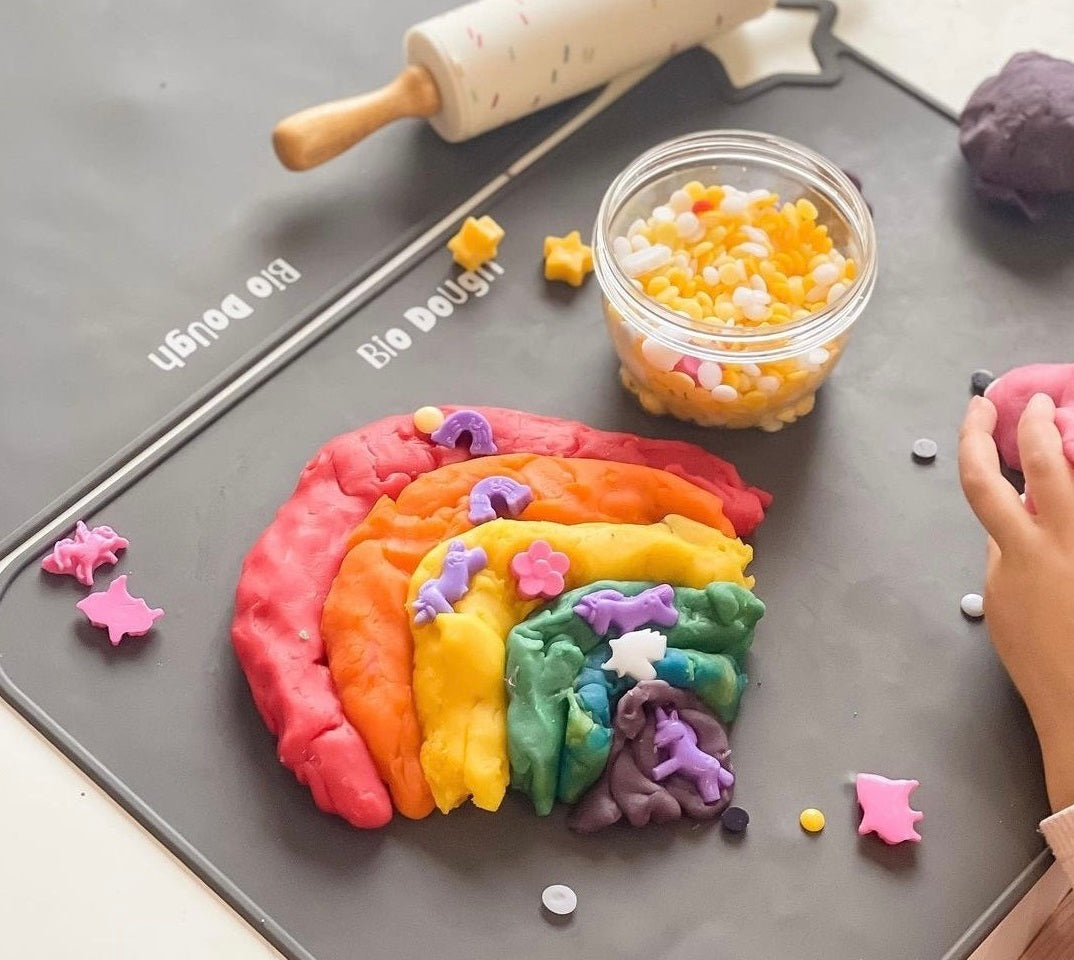
The Bio DoUgh silicone play mat can create a defined surface. Bio DoUgh also offers free themed printables for animals, dinosaurs, unicorns, transport, food, counting and letter play.
Why Choose Bio DoUgh for Repeat Play?
Bio DoUgh is Australian made with 100% food-grade ingredients sourced from certified Australian suppliers. It is designed to stay soft and highly malleable, which makes it useful across simple pressing, rolling, cutting and model-building activities. If otherwise clean Bio DoUgh dries slightly, it can be refreshed with a few drops of water according to current care guidance.
Bio DoUgh is recommended for ages two and over, contains wheat and is not meant to be eaten. Selected accessories may have separate 3+ warnings, so check each page and package.
Bio DoUgh's Scent-Free and Dye-Free Bio DoUgh is another useful point of difference. With no added fragrance or artificial dye, it lets an activity focus on texture, tools and storytelling without extra scent or colour. It retains the brand's soft, malleable texture and should be used with the same age, allergen and supervision checks.
The Bio DoUgh Mega Value Bundle can suit families who want multiple colours, a rolling pin, mat, cutters and storage containers for repeat activities. Contents and pricing can change, and some included items may have their own age guidance, so check the live product page before buying.
Frequently Asked Questions
What can a two-year-old do with playdough?
Start with dough-only actions such as squishing, poking, patting and making one large ball. Keep the session short, stay within reach and avoid small accessories. Follow Bio DoUgh's 2+ guidance and your child's readiness.
Which playdough activities support fine-motor practice?
Rolling, pressing, pinching, poking, cutting with age-appropriate tools and placing larger pieces all give the hands different movements to practise. See the dedicated fine-motor guide for a careful explanation of benefits and limits.
Are playdough activities educational?
They can create opportunities to talk, compare, count, solve problems, tell stories and use the hands. The learning comes from the interaction and practice, not from playdough automatically teaching a skill.
Can children use beads, buttons or sequins with playdough?
These can be choking hazards and should not be offered to children under three or to any child who mouths objects. Choose large, age-appropriate tools and follow ACCC guidance and product labels.
How many colours should I offer?
One colour is enough for a toddler or a quick activity. Two or three colours give choices without making the setup overwhelming. Keep unused tubs closed.
What if my child mixes every colour together?
Colour mixing is valid experimentation. Offer small portions if you want to preserve the main tubs, or choose compatible groups using Bio DoUgh's FAQ guidance.
How long should playdough play last?
Follow the child's interest. A focused five-minute toddler session can be complete, while an older child might build a story for much longer. End when the child is tired, distressed or starting to use the material unsafely.
How do I include a child who dislikes messy textures?
Offer a roller, large cutter or tool, use a smaller piece, let the child watch first or place dough inside a sealed bag for visual pressing. Do not force direct touch.
The Bottom Line
These twenty playdough activities work best as invitations, not instructions that must be completed. Start with a clean surface and one clear idea, then follow where the child takes it. Adapt tools to age and ability, avoid small parts for under-threes and keep the dough out of mouths.
For families building a reusable activity kit, the Bio DoUgh Mega Value Bundle brings together multiple colours, tools and storage. Check the current page for inclusions and age guidance.
Sources and Fact-Checking Notes
- Raising Children Network playdough activities: child-led play, common playdough actions, tools and age adaptation.
- ACECQA play-based learning and intentionality: adult and child roles, idea testing, relationships and new understandings through play.
- ACECQA resources support play-based learning: open-ended materials, exploration, problem solving and creation.
- ACCC kids' toys guide: age labels, mouthing and small-parts safety.
- NHMRC healthy environment guidance: playdough hand hygiene, storage and contamination guidance.
- Bio DoUgh FAQ: age, ingredients, wheat, colour groups, airtight storage and rehydration.
- Bio DoUgh Scent-Free and Dye-Free dough: current product-specific fragrance, dye and texture information.
- Bio DoUgh free printables: currently available theme categories.
This article provides general play ideas. Always follow the product and accessory labels, supervise children and adapt activities to individual needs.