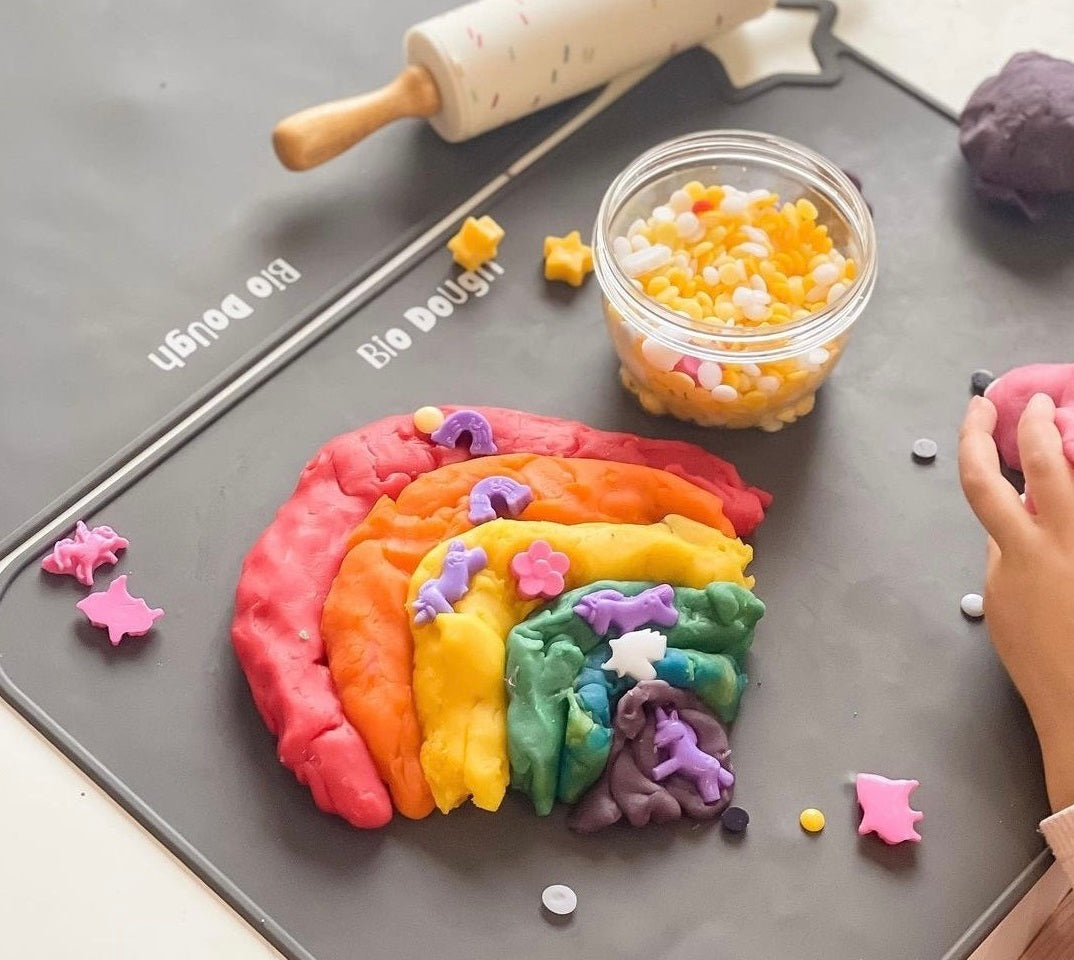

Playdough can support fine-motor practice because children use their hands and fingers in many ways. Pressing and squeezing use the whole hand. Pinching and poking need smaller, more controlled movements. Rolling, cutting and stamping bring both hands, the eyes and simple tools into play.
That does not mean playdough fixes a delay, guarantees pencil control or replaces occupational therapy. It is an open-ended material. Children can enjoy practising the same movements at their own level.
What Each Playdough Action Practises
| Playdough action | Main movement opportunity | Everyday connection |
|---|---|---|
| Squeeze a ball | Whole-hand grasp and release | Holding and letting go of objects |
| Press with a palm | Shoulder, wrist and hand working together | Steadying the arm for tabletop tasks |
| Roll a snake | Two hands moving together | Coordinating both sides of the body |
| Pinch an edge | Thumb and fingertip control | Picking up small everyday items |
| Poke dots | One finger moving with control | Pointing, tapping and using buttons |
| Make tiny balls | Fingertip rotation and pressure | Manipulating small safe objects |
| Flatten with a roller | Two-hand pressure and direction | Using one hand to guide while both work |
| Push a cutter | Graded downward pressure | Opening containers and using tools |
| Cut with dough scissors | Repeated open-and-close movement | Early scissor use |
| Build a model | Planning, placing and adjusting pieces | Coordinated object use and problem solving |
What Are Fine-Motor Skills?
Fine-motor skills are small, controlled hand movements. Children use them to pick up food, hold a toothbrush, turn pages, use fasteners, draw and cut.
Australia's Pregnancy, Birth and Baby service says fine-motor skills include grasping, gripping and pinching. It lists rolling playdough as one everyday example. Children build these skills at different rates.
Fine-motor performance is not just "finger strength". It can involve:
- Hand and finger strength
- Dexterity, or changing and controlling small movements
- Hand-eye coordination
- Using both hands together
- Keeping the wrist and forearm stable while the fingers work
- Planning a movement and adjusting pressure
- Sensory information about touch, resistance and body position
Playdough can help with several of these areas. It pushes back gently and can be reshaped at once.
Seven Ways Playdough Supports Hand Practice
1. It gives the whole hand resistance
Squeezing a soft ball asks the fingers to close around resistance, then open again. The effort can be adjusted easily by changing the size and softness of the piece.
2. It invites thumb-and-finger movements
Pinching spikes, petals or a pretend pie crust uses the thumb opposite one or more fingers. The action resembles the controlled pick-up movements children use in many daily tasks.
3. It encourages both hands to cooperate
Rolling a long rope gives both hands a job. So does holding a model while adding a piece or keeping the mat still while using a cutter. Sometimes both hands do the same job. At other times, one hand holds while the other moves.
4. It gives immediate visual feedback
Children can see a deep mark when they press hard and a shallow mark when they press lightly. They can adjust without waiting for an adult to say whether the result is right.
5. It allows repetition without a worksheet
A child might pinch twenty spikes onto a dinosaur because the idea is interesting. The repeated movement grows naturally from the play rather than from drilling a hand exercise.
6. It introduces simple tools
A roller, large cutter, stamp or age-appropriate dough scissors changes the movement required. Tool use can add practice in grip, pressure, direction and release.
7. It supports planning and repair
When a tall model falls, the child can make the base wider, add support or start again. This combines hand movement with experimentation and problem solving.
Ten Fine-Motor Playdough Activities
1. Big squeeze warm-up
Give the child one soft ball and invite five slow squeezes in each hand. Then let them choose what to make. Do not continue if the hand hurts or tires quickly.
2. Palm pancakes
Press a ball flat with one palm, turn it over and press again. Try two hands together or alternate left and right.
3. Two-hand snakes
Roll a thick rope with both palms. Progress from a short rope to a longer one only if the child is interested.
4. Pinch-pot bowl
Push a thumb into a ball, then pinch around the edge to make a simple bowl. Large, uneven bowls are completely acceptable.
5. Hedgehog spikes
Form a body, then pinch the surface repeatedly to make spikes. For a younger child, make five large spikes rather than many tiny ones.
6. Fingerprint trail
Flatten the dough and make a path using one fingertip at a time. Follow the trail with a toy that is clearly age-appropriate.
7. Tiny-ball collection
Use a small amount of dough to roll balls between a thumb and one or two fingertips. Keep every piece on the mat and do not use this activity with a child who mouths objects.
8. Cutter press and peel
Flatten dough with a roller, push a large cutter down and peel the extra dough away from the shape. The child can hold the cutter with one or both hands.
9. Dough-scissor fringe
Roll a thick strip and use blunt, age-appropriate dough scissors to make short snips along one edge. Follow the tool label and supervise directly.
10. Build and balance
Make a base, add two or three pieces and see how tall the model can stand. Invite the child to change the base when it wobbles.
A Simple Progression From Easier to Harder
| Start here | Add a challenge | Reduce the challenge |
|---|---|---|
| Large soft ball | Use a smaller piece | Warm and knead the dough first |
| Whole-palm press | Use fingertips only | Press with both palms |
| Thick snake | Make it longer or thinner | Adult starts the roll |
| Large cutter | Try a smaller approved cutter | Use two hands on the cutter |
| Five big pinches | Make a repeating edge | Flatten the dough for easier access |
| One-piece model | Join several parts | Build side by side with the adult |
Increase only one difficulty at a time. A child who is concentrating on a new tool might not also need a counting, letter or speed challenge.
Does Playdough Improve Handwriting?
Playdough can help children practise hand strength, control and tool use. Handwriting needs much more. It also involves posture, vision, language, attention, letter knowledge and time with drawing and writing tools.
It is more accurate to say playdough supports hand movements used in daily tasks. Do not promise that it will improve pencil grip or handwriting. Let children also draw, paint, build, dress themselves and use safe real-world tools.
What Does the Evidence Say?
Australian parent and early-learning guides include playdough as open-ended hand play. The Raising Children Network says squeezing, pinching and pulling give the hands useful practice. ACECQA also supports flexible resources that children can use to explore, solve problems, create and build.
Some small preschool studies report better fine-motor scores after set playdough programs. For example, a 2019 study involved 26 children aged four to six. The authors called for stronger randomised research. These results are promising, but the studies were small and not randomised. They do not prove that a playdough session will produce the same result for every child.
The key point is simple. Playdough gives the hands useful practice during fun play. It should sit beside other daily activities, not be sold as treatment.
Make It Child-Led, Not a Hand Workout
Children are more likely to repeat an action when it helps their own idea. Instead of asking for ten exercises, try:
- "Would you like to make a road or a creature?"
- "What tool will help with that part?"
- "This piece keeps falling. What could we change?"
- "Would you like help, or will you try another way?"
- "Show me the part you like best."
Model one technique, then step back. Describe what the child is doing without correcting every grip or shape.
Adaptations for Different Hands and Sensory Preferences
| Child's response | Possible adaptation |
|---|---|
| Dough feels too firm | Warm and knead it in adult hands first, or use a smaller piece. |
| Child avoids touching | Offer a roller or cutter, allow one-finger contact or use dough inside a sealed bag. |
| Grip tires quickly | Use brief turns, bigger pieces and whole-palm actions. Stop before fatigue becomes frustration. |
| One hand is used much more | Place the dough at the centre and invite two-hand tasks without forcing symmetry. |
| Tools slip | Use a non-slip mat and a tool with a larger handle. |
| Child seeks strong pressure | Offer a large soft piece for pushing and flattening on a stable surface. |
| Child needs more challenge | Add model-building, controlled cutting or small dough pieces only when age and mouthing behaviour allow. |
Every child has a different history. Change the play so the child can join in. Do not demand one standard result.
When to Ask an Occupational Therapist
Every child develops at a different pace. Seek advice if pain, weakness, hand skills or sensory responses limit your child's play or daily care.
Start with your GP or child and family health nurse, or contact a registered occupational therapist. Healthdirect explains that occupational therapists can help people use their hands. It also notes that a GP referral may help with some funding claims.
An occupational therapist can assess the whole child. They can suggest play ideas, equipment or changes that suit the child's needs. A blog cannot provide that personal assessment.
Safety Still Comes First
- Follow the dough and tool age labels.
- Bio DoUgh is recommended for ages two and over and contains wheat.
- Keep dough out of mouths. Non-toxic does not mean edible.
- Avoid small tools and decorations for children under three or anyone who mouths objects.
- Use blunt, age-appropriate dough scissors only with direct supervision.
- Wash and dry hands before and after play.
- Stop if the child reports pain or shows unusual fatigue.
- Discard contaminated dough and store clean dough airtight.
- Read the complete Bio DoUgh playdough safety guide for allergens, mouthing and hygiene.
Why Choose Bio DoUgh for Fine-Motor Play?
Bio DoUgh is Australian made using 100% food-grade ingredients from certified Australian suppliers. Its soft texture makes pressing, rolling and pinching easier than with a very firm material. If clean dough starts to dry, a few drops of water can soften it. Follow the current care instructions.
Bio DoUgh is recommended for ages two and over, contains wheat and is not edible. Accessories can have different age warnings.
Families who prefer dough without added scent or colour can choose Scent-Free and Dye-Free Bio DoUgh. This product has no added fragrance or artificial dye and keeps Bio DoUgh's soft texture. It may suit a sensory preference, but it does not promise a clinical result. The current label and allergen guidance still apply.
| Bio DoUgh feature | Relevance to hand play |
|---|---|
| Soft, malleable texture | Supports whole-hand and fingertip actions with adjustable resistance. |
| Multiple colours | Allows sorting, pattern and model-building choices without changing the basic hand movements. |
| Rehydratable when clean | Helps families maintain a workable texture rather than using dry, cracking dough. |
| Rolling and cutting tools | Can add two-hand pressure and tool-control activities when age-appropriate. |
| Airtight containers | Keep clean portions separate and ready for repeated short sessions. |
The Bio DoUgh Mega Value Bundle currently combines multiple dough colours, a rolling pin, cutters, mat and storage containers. Check the current inclusions and each item's age guidance before use.
Frequently Asked Questions
Does playdough strengthen children's hands?
Squeezing and pressing dough provide resistance for the hand muscles, while pinching and tool use add controlled movements. This can support practice, but the effect varies with the activity, dough texture, repetition and child.
Which playdough action is best for fine-motor skills?
There is no single best action. Squeezing, rolling, pinching, poking, cutting and building each ask for different movements. A varied, enjoyable session is more useful than repeating one forced exercise.
Is playdough good for pencil grip?
It can practise some underlying hand movements, but pencil grip and handwriting depend on many factors. Provide drawing and writing opportunities too, and seek professional advice if you have concerns.
How long should a fine-motor playdough session last?
Follow the child's engagement and comfort. Five to ten minutes can be enough for a toddler. An older child may play longer. Stop before pain, unusual fatigue or frustration.
Should I correct the way my child holds a tool?
Make sure the grip is safe, then allow experimentation. Model a comfortable method and offer a larger handle if needed. Persistent difficulty that affects daily participation is better discussed with an occupational therapist than corrected repeatedly during play.
Can a two-year-old do these activities?
Use dough-only actions such as squeezing, palm pressing, poking and thick rolling, with direct supervision. Avoid small pieces, scissors and loose accessories. Follow Bio DoUgh's 2+ guidance and your child's readiness.
Can playdough replace occupational therapy exercises?
No. Playdough can be one part of a therapist's plan. General blog ideas do not replace an assessment or advice made for one child.
What if my child refuses to touch playdough?
Do not force contact. Offer a tool, a smaller amount or dough inside a sealed bag, or choose another material. Sensory preferences are valid and can change over time.
The Bottom Line
Playdough supports fine-motor practice through many hand actions. Squeezing, rolling, pinching, poking, cutting and building each require a different mix of strength, control and tool use.
Keep sessions child-led, adjust the resistance and challenge, and treat progress as individual. For a ready-to-use set with several colours and tool options, explore the Bio DoUgh Mega Value Bundle. Check the current age and product guidance before use.
Sources and Fact-Checking Notes
- Pregnancy, Birth and Baby toddler motor skills: Australian explanation of fine-motor skills and rolling playdough as an example.
- Raising Children Network playdough activities: squeezing, pinching, pulling, tools, creativity and age adaptation.
- ACECQA resources support play-based learning: open-ended materials, exploration, construction and problem solving.
- Healthdirect occupational therapy: scope, hand-use support, registration and referral information.
- Royal Children's Hospital fine-motor information: definition of fine-motor skills and occupational therapy assessment. The page is specific to brain injury, so it is not used to generalise developmental outcomes.
- 2019 playdough fine-motor study abstract: small quasi-experimental preschool study and its call for stronger randomised research.
- Bio DoUgh FAQ: age, ingredients, wheat, storage and rehydration guidance.
- Bio DoUgh Scent-Free and Dye-Free dough: current product-specific fragrance, dye and texture information.
This article provides general play and development information. It does not diagnose or treat a fine-motor difficulty.