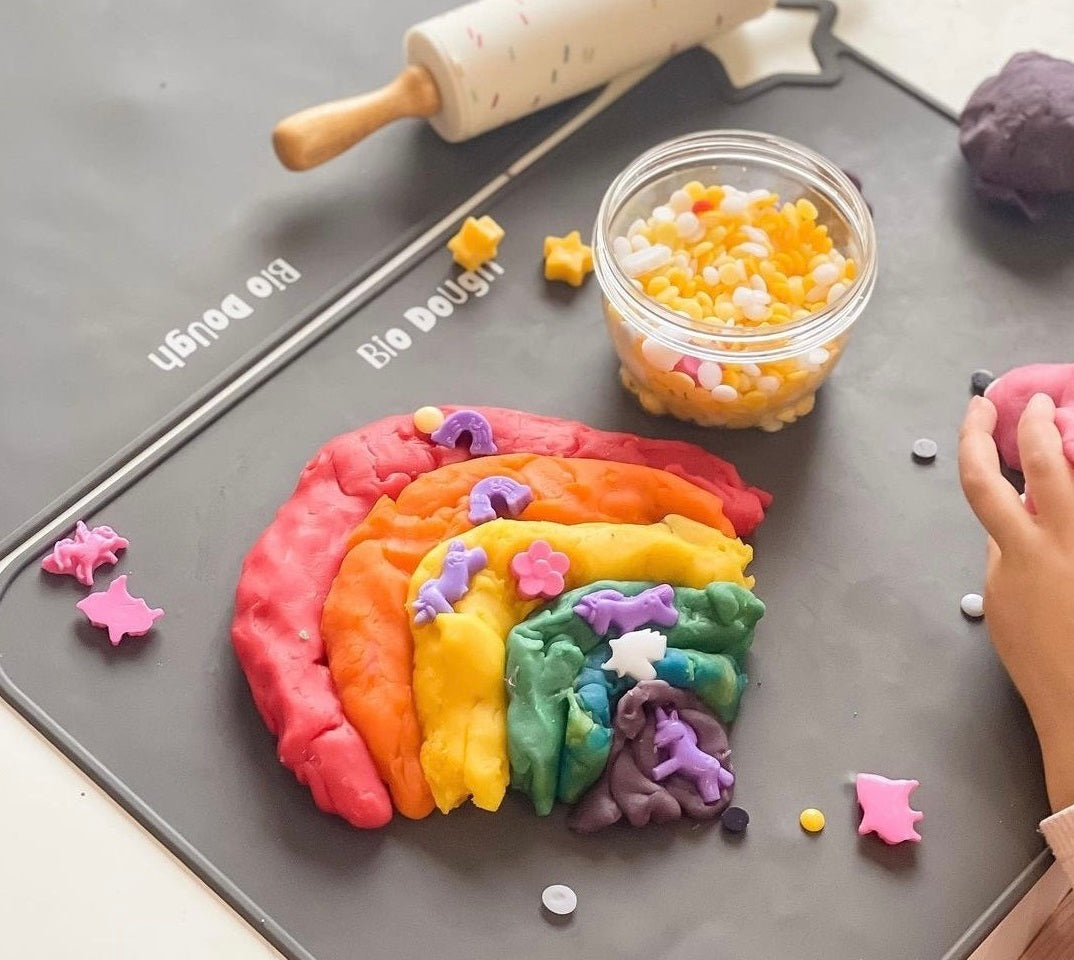
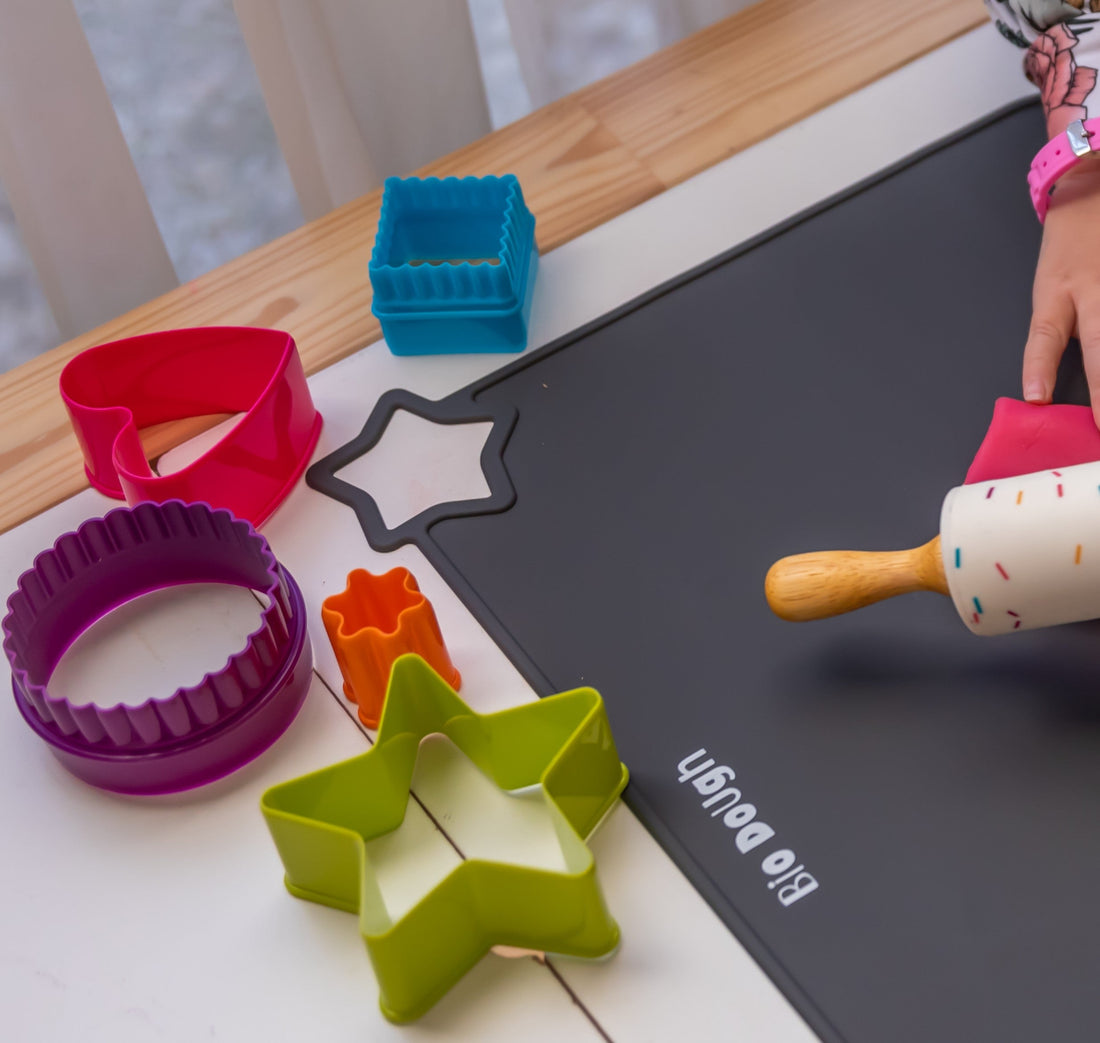
Playdough looks simple. Soft, colourful Bio DoUgh on a clean mat and a willing child. But what happens during a playdough session is anything but simple. In those quiet minutes of pressing, rolling, pinching and building, children are developing skills that connect directly to how they move, communicate, learn and feel throughout their lives.
The benefits of playdough span eight key areas of child development. This guide covers each one in detail, explains how they show up at different ages, and looks at why the quality of the playdough itself makes a genuine difference.

The benefits of playdough for children include fine motor skill development, sensory exploration, creativity and imagination, language and vocabulary growth, early maths and literacy, emotional regulation, social skills and school readiness confidence. Research from the National Association for the Education of Young Children confirms that playdough supports development across physical, cognitive, language and social-emotional domains. Bio DoUgh is recommended for children aged two and over.
1. Fine Motor Skills and Hand Strength
Building the muscles children use for writing
Every time a child squeezes, rolls, pinches or flattens playdough, they are working the small muscles in their fingers and hands. These are the same muscles that control a pencil, manage buttons and fastenings, turn pages and manipulate everyday objects. Michigan State University Extension notes that the hand and finger strength built through playdough play directly supports later skills such as cutting and holding a pencil with a pincer grasp.
The specific movements that develop fine motor skills
Each playdough action targets a slightly different skill set. Squeezing builds grip strength. Pinching develops the thumb-fingertip opposition that writing requires. Rolling with both palms improves bilateral coordination. Pressing a cutter into flat dough develops graded pressure control. Pulling small pieces apart and joining them back together builds dexterity and proprioception. A single session typically involves many of these movements, making playdough one of the most comprehensive fine motor activities available for young children.
2. Sensory Exploration and Brain Development
Touch and texture as learning tools
Playdough gives children direct, adjustable sensory feedback. Press softly and the surface barely changes. Press hard and you leave a deep mark. The dough responds to every variation in pressure, speed and direction, helping children build a detailed understanding of how their bodies interact with materials. This tactile feedback strengthens the neural pathways that support sensory processing, hand-eye coordination and physical self-awareness.
How scent enriches the sensory experience
Scent is a powerful and often overlooked sensory dimension in play. Bio DoUgh comes in a wide variety of colours, each with its own unique natural scent. Adding a pleasant, distinct aroma to a tactile activity engages a second sensory pathway simultaneously, deepening the play experience and making each session more memorable. The Gowrie NSW early childhood research confirms that scented playdough taps into children's sense of smell in ways that enrich the overall sensory environment.
3. Creativity and Imagination
Open-ended play with no limits
Playdough has no instructions, no correct outcome and no finished shape that needs to match a picture. That freedom is exactly what makes it such a powerful creative tool. Children can make whatever they want, change it immediately and start again at any point. This models a growth mindset: the idea that attempts are worth making even before you know how they will turn out.
Symbolic thinking and storytelling
The NAEYC highlights that when a child announces their playdough lump is a moose, they are practising symbolic thinking: the ability to let one thing represent another. This cognitive flexibility is the same skill that underlies reading, where letters stand for sounds, and mathematics, where numbers stand for quantities. Story-based playdough play, where characters, settings and problems emerge from the dough, is one of the richest forms of symbolic and narrative thinking available to young children.
4. Language and Communication
Describing, questioning and narrating
Playdough sessions naturally generate conversation. Children describe what they are making, explain their decisions and react to what others are creating. Descriptive language flourishes: squishy, smooth, lumpy, flat, long, tiny, heavy, soft. Action vocabulary emerges: roll, pinch, squash, cut, stamp, poke. The NAEYC notes that playdough supports language development because children use words to invent stories, compare actions and explain their thinking in real time.
Adult conversation as a multiplier
When an adult participates, language development accelerates. Asking open questions ("What does this feel like?" "What is your creature going to do next?"), making observations and narrating shared actions builds vocabulary, sentence structure and listening skills. These interactions directly support the communication abilities children need as they move into early learning settings.
5. Early Maths and Literacy
Counting, measuring, comparing and shapes
Playdough is a hands-on maths resource. Children count their creations, compare which snake is longer, sort pieces by size or colour and notice that flattening a ball changes its shape but not its amount. Using cutters introduces children to geometry: circles, stars, squares and hearts become familiar through physical contact rather than abstract instruction. Following a simple playdough recipe introduces measurement concepts and cause-and-effect thinking when ingredients are combined.
Letters, numbers and school readiness
Rolling thin ropes and bending them into letter shapes is one of the most natural and effective ways to build letter familiarity before formal writing begins. The physical experience of forming each letter's shape, feeling where the lines turn and join, supports the visual memory children use when they later write with a pencil. Bio DoUgh's free themed printables include letters and numbers, giving children a visual reference to match their dough creations alongside.
6. Emotional Wellbeing and Calm Focus
The calming effect of playdough
The repetitive, rhythmic movements of kneading and rolling have a demonstrably calming effect on the nervous system. Gowrie NSW research notes that playdough works in a similar way to a stress ball, reducing excess energy and helping children settle. It is particularly effective during transitions, after stimulating activities or at times when a child needs to regulate their energy before focusing on something else.
A safe outlet for big feelings
Pounding, squishing and pulling playdough gives children a physical outlet for strong emotions without any risk of harm. The NAEYC specifically recommends playdough when children seem stressed or angry, as a productive and satisfying way to release and process those feelings. Children who engage in this type of physical play often emerge calmer, more focused and better able to re-engage with others.
7. Social Skills and Collaboration
Sharing, turn-taking and cooperation
Group playdough sessions are naturally collaborative. Children negotiate access to cutters and tools, share colours, watch each other's techniques and comment on each other's creations. These interactions are low-stakes and informal, making them an ideal environment for practising the social skills that early childhood education settings actively build: sharing, requesting, listening and acknowledging others.
Building together, learning together
Collaborative playdough projects, where children contribute pieces to a shared scene or story, develop communication and problem-solving skills in a genuinely playful context. Research cited by MFS Ready Set Go confirms that when children make and play with playdough together, they enhance their social skills through sharing, turn-taking and cooperation in a natural, enjoyable way.
8. Confidence and School Readiness
Because playdough has no wrong answer, every child succeeds at every session. A child who is still developing their coordination makes something. A child who is a skilled sculptor makes something. Both feel proud of their creation. This consistent experience of competence, where effort is rewarded with a visible, tangible result, builds the confidence and creative resilience that children carry into formal learning environments.
School readiness is not only about academic skills. It includes the ability to focus, persist, collaborate, communicate and recover from difficulty. Playdough develops all of these qualities naturally, making it one of the most complete school-readiness activities available at home.
Benefits by Age: What to Expect at Each Stage
| Age group | Key developmental focus | Recommended activity type |
|---|---|---|
| 2 years | Sensory discovery, grip strength, cause and effect | Squeezing, poking, patting and simple rolling with direct supervision |
| 3 years | Fine motor precision, shape recognition, language growth | Large cutters, rolling, pretend food and simple storytelling |
| 4 years | Symbolic thinking, early maths, collaboration | Letter and number building, pattern making, group story scenes |
| 5 to 6 years | Planning, persistence, detailed model building, school readiness | Multi-step models, collaborative worlds, counting, writing-linked play |
For a full guide to age readiness and how to introduce playdough to young children, read the playdough age and readiness guide.
How Bio DoUgh Enhances Every One of These Benefits
The quality of the playdough shapes the quality of the developmental experience. Dough that is too stiff frustrates small hands. Dough that crumbles disrupts fine motor practice. Dough without scent misses an entire sensory dimension. Bio DoUgh is made in Australia using 100% food-grade ingredients from certified Australian suppliers, designed specifically to support the kind of extended, engaged, multi-sensory play that delivers the most developmental benefit.
| Bio DoUgh feature | How it supports development |
|---|---|
| Soft, highly malleable texture | Allows children to build hand strength without frustration. The right resistance for little hands from age two. |
| 18 natural scents | Engages the sense of smell alongside touch for richer multi-sensory learning. Each colour delivers a distinct aromatic experience. |
| Rehydratable formula | Extends the life of the dough, making repeat sessions possible without the texture degrading over time. |
| Full accessories range | Rolling pins, shape cutters, silicone mats and themed printables extend the developmental range of every session. The Bio DoUgh accessories range grows with the child. |
| 100% food-grade ingredients | Gives families confidence in the material, supporting longer and more relaxed play sessions. For full ingredient details, read is playdough safe and non-toxic. |
"The kids love how soft and squishy this dough is! Scents are great. Lovely customer service!"
— Samantha P."My kids love Bio Dough. It is so soft, smells amazing, and is perfect for play!"
— Kim M.Frequently Asked Questions
What are the main benefits of playdough for toddlers?
For toddlers aged two and over, the primary benefits are sensory exploration, hand and finger strength, cause-and-effect understanding and early language development. Start with simple squeezing, poking and rolling, using dough only. Add tools gradually as the child's readiness grows. See the playdough age and readiness guide for a complete toddler setup guide.
How does playdough help with fine motor skills?
Playdough works the small muscles in the fingers and hands through a wide variety of movements: squeezing, pinching, rolling, pressing, cutting and building. These actions build the strength, dexterity and coordination that children use for writing, drawing, using scissors and managing fastenings. Michigan State University Extension confirms that these fine motor gains directly support later pencil grip and cutting ability.
Does playdough actually help children learn?
Yes. The NAEYC confirms that playdough supports development across physical, cognitive, language and social-emotional domains simultaneously. Children learn through sensory exploration, symbolic thinking, problem solving, storytelling, counting and vocabulary development, all within a single open-ended play session.
How does playdough support emotional development?
The repetitive, rhythmic actions of kneading, rolling and squeezing have a calming effect on children's nervous systems. Playdough gives children a physical outlet for strong feelings, helps them regulate their energy during transitions and provides a focused, absorbing activity that builds attention span. Both the NAEYC and Gowrie NSW early childhood research support playdough as a tool for emotional regulation.
Is scented playdough more beneficial than unscented?
Scented playdough adds an additional sensory dimension by engaging the sense of smell alongside touch. This multi-sensory combination deepens the play experience and supports richer sensory processing. Families who prefer a neutral option can choose the Scent-Free and Dye-Free Bio DoUgh, which delivers the same soft texture without added fragrance.
How often should children play with playdough to see benefits?
Regular short sessions are more beneficial than occasional long ones. Two to three sessions per week of ten to twenty minutes each builds cumulative hand strength, vocabulary and creative confidence over time. Follow the child's interest and engagement rather than setting a rigid schedule.
What accessories increase the developmental benefits of playdough?
Rolling pins add two-hand coordination and graded pressure. Shape cutters introduce geometry and graded downward force. Dough scissors develop the open-and-close movement needed for paper cutting. Themed printable mats add letter, number and visual literacy connections. Explore the full Bio DoUgh accessories range for age-appropriate tools that extend developmental learning.
Can homemade playdough deliver the same benefits?
Homemade playdough can deliver many of the same developmental benefits when the texture is right and the session is well supervised. The main differences are texture consistency, scent variety and ingredient quality. For a reliable homemade option, follow the Bio DoUgh homemade playdough guide for a full recipe and step-by-step instructions.
Start Experiencing the Benefits with Bio DoUgh
Eight developmental benefits. One simple activity. Playdough is one of the most efficient and enjoyable tools available for supporting children through the years when their brains, bodies and social worlds are developing most rapidly.
Explore the full Bio DoUgh natural playdough range to find the right colours for your family. For a complete kit with dough, tools and storage, the Bio DoUgh Mega Value Bundle brings everything together in one great-value pack.